

By Lynn Räbsamen, CFA | COO, Global Swiss Learning | Advisory Board Member, CFA Institute | Author, Artificial Stupelligence
“The mistake isn’t the model. It’s that nobody asks what happens when the regime changes.”
A Stanford Graduate School of Business study landed in my inbox recently with the kind of headline that makes financial professionals do a double-take. Researchers had built an AI analyst, fed it 30 years of public market data, and discovered it beat 93% of human mutual fund managers — by an average of 600%. The team was so shocked by their own results that they spent a full year hunting for errors. They found none.
The study’s lead researcher, Ed deHaan, put it bluntly: between 1990 and 2020, real fund managers generated $2.8 million of alpha per quarter. His AI analyst generated $17.1 million on top of that — just by tweaking existing portfolios at the margin, using nothing but publicly available information.
I’ll be honest: those numbers are genuinely impressive. They also tell an incomplete story. And that incomplete story is the most important thing a finance professional needs to understand before handing their portfolio — or their clients’ portfolios — to a machine.
The Party Trick vs. The Flood Test
Here’s what the Stanford AI analyst actually did: it looked backwards. It was trained on market data from 1980 to 1990, identified 170 variables that correlated with future stock performance, and then applied that framework forward. Simple variables, like firm size and trading volume, did most of the heavy lifting. The AI’s edge was processing these signals faster and more systematically than humans.
That’s a very impressive party trick. But a party trick performed in a controlled room is not the same as a flood test. The question nobody in the headline asked is: what happens to a model trained on a specific market regime when that regime ends?
The answer, as any CFA charterholder will tell you, is: nothing good.
The CFA Concept Everyone Forgets to Ask About
Regime change. Two words that appear throughout the CFA curriculum and disappear almost entirely from AI investing conversations.
At its most basic, a market regime is a persistent set of conditions — a particular relationship between inflation, interest rates, growth, and risk appetite — that shapes how assets behave relative to each other. Mean-variance optimization, the mathematical foundation of modern portfolio construction, assumes those relationships are stable. They are not.
The CFA Institute is explicit about this limitation. Time-series models rely on covariance stationarity — the assumption that a series’ mean, variance, and correlation structure remain constant over time. When they don’t, the models produce what the curriculum calls spurious results: high confidence, impressive-looking outputs, and completely unreliable forecasts. It’s the financial equivalent of predicting tomorrow’s weather using only last summer’s data.
The minimum-variance frontier — the efficient portfolio boundary that every Level I candidate learns to construct — is not a fixed line. It shifts when the underlying risk and return relationships between assets shift. Small changes in the correlation matrix can cause massive changes in recommended portfolio weights. This is not a bug in the model. It is a documented, well-understood property of the math.
The question is whether AI tools account for it. In my testing of both ChatGPT and Claude, the answer is: not by default, and not reliably.
I Tested This. Here’s What I Found.
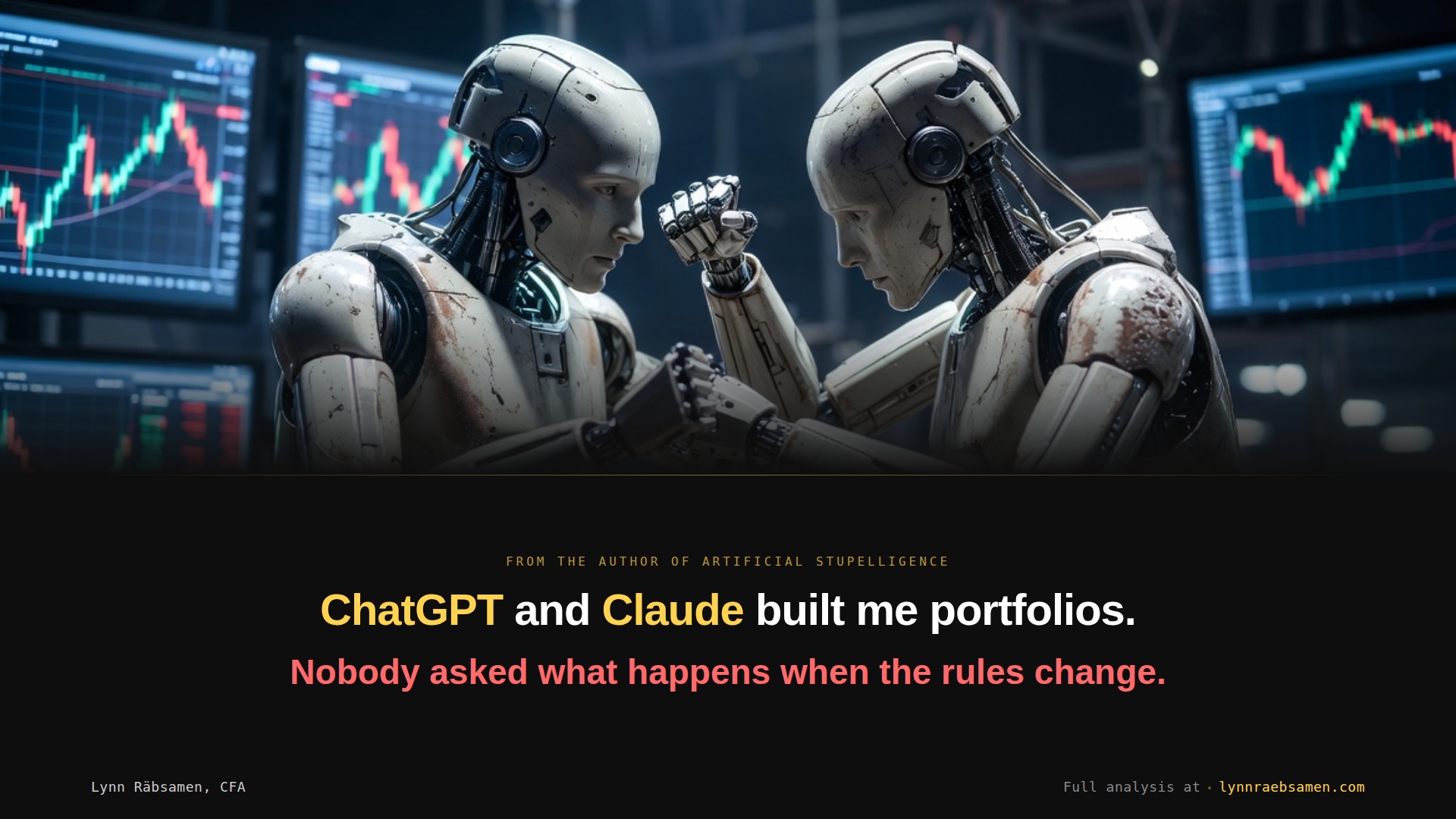
When I ran my own ChatGPT vs. Claude portfolio experiment earlier this year — giving both models identical mandates to construct AI infrastructure portfolios using a ‘picks and shovels’ strategy — neither model was asked to stress-test for regime change. Neither volunteered to.
Claude’s concentrated infrastructure portfolio outperformed ChatGPT’s diversified approach by 5.28% annually in backtesting, producing a $108,917 wealth gap on a $100,000 starting position. That’s a genuinely interesting result. But the backtest period covers a specific macro regime: post-pandemic recovery, AI infrastructure boom, relatively contained inflation. Neither model was asked: what happens if rates rise sharply? What happens if the correlation between semiconductors and the broader market breaks down? What happens if we enter a risk-off environment where the ‘picks and shovels’ thesis gets repriced?
They weren’t asked because the user — me — didn’t ask. And that’s exactly the problem.
“The AI isn’t making the mistake. The human using it is. But that’s a distinction without much practical difference when the losses show up.”
When the Regime Changed: Three Cautionary Tales
This is not a theoretical concern. Here are three cases where the regime shift arrived and the models didn’t.
2008: The Correlation Catastrophe. Before the Global Financial Crisis, pairwise equity correlations across global markets sat at approximately 0.40. During the acute phase of the crisis, they surged to 0.70 — and stayed elevated for more than five years. A portfolio diversified across U.S. stocks, bonds, international equities, emerging markets, and REITs saw its effective equity beta rise from 0.65 to 0.95. In plain terms: everything moved like stocks. Every model trained on pre-crisis correlations was operating with a map of a city that no longer existed.

2022: The Bond Market’s Worst Year in 150 Years. The stock-bond negative correlation regime that had held for 23 years — from 1997 to 2020 — ended in approximately six months. The equity-bond correlation flipped from its post-2000 average of -0.20 to -0.63 all the way to +0.65 to +0.70. The S&P 500 fell 18.1%. The Bloomberg US Aggregate Bond Index fell 13.0% — its worst drawdown since the index’s inception in 1976. The 60/40 portfolio, the bedrock of institutional allocation, lost roughly 16-18%. In 150 years of data, this was the only period where the 60/40 portfolio’s decline was more painful than simply holding all equities. Any AI model trained on the previous two decades of stock-bond relationships walked straight into this.

2025: The Quant Winter. The most recent episode. AI-driven quant funds, optimized for historical factor relationships — momentum, value, mean reversion — encountered a market dominated by speculative rallies in low-quality stocks. Goldman Sachs prime brokerage data showed the worst ten-day period for systematic long-short equity managers in more than three months in early 2026. The diagnosis: algorithms optimized for historical regimes struggle to adapt when sentiment and liquidity become the primary market drivers. The models weren’t wrong. They were right about the wrong era.

The IBM Watson Test Case
For a concrete data point on AI investing tools specifically, consider the AIEQ ETF: the Amplify AI Powered Equity ETF, launched in 2017, powered by IBM Watson. It was the first actively managed ETF to use artificial intelligence for stock selection, analyzing millions of data points across news, social media, earnings calls, and financial statements for over 6,000 U.S. companies.
In 2022 — the year the inflation regime shifted and both stocks and bonds fell simultaneously — AIEQ fell 31.90%. Its category fell 14.01%. The model trained on a low-inflation, falling-rate environment met an inflation shock and performed roughly twice as badly as its peers.
This is not a verdict on AI investing broadly. It is a data point on what happens to models that don’t build regime awareness in explicitly.
The Intellectual Honesty Section (Yes, There Is One)
To be clear: sophisticated institutional systems can and do account for regime change. Two Sigma, AQR, and BlackRock’s systematic investment teams build explicit regime-detection models into their processes. These are purpose-built, heavily resourced, institutionally validated frameworks developed by teams of PhDs with access to proprietary data.
They are not ChatGPT with a portfolio prompt.
The academic literature also shows that ML models specifically designed with regime-switching architecture can outperform static approaches. A 2025 Nature study found that a Long Short-Term Memory framework with embedded regime-detection limited COVID-period losses to 18.3%, compared to 29.7% for traditional risk parity. That’s real progress.
But these systems are built to solve the regime problem explicitly. The general-purpose LLMs most investors are actually using were not designed for this. They were trained on historical data to produce coherent, pattern-consistent outputs. In stable conditions, that works well. In regime transitions, it is precisely the wrong tool.
So What Should You Actually Do?
The Stanford study is correct that AI can process public information more efficiently than humans. That finding is solid and will reshape how data analysis is done in investment management. But efficiency at processing historical data is not the same as wisdom about what happens when the rules change.
A few practical principles for finance professionals using AI investing tools:
- Always ask explicitly about regime assumptions. When an AI tool builds you a portfolio or validates a thesis, ask: what macro regime is this optimized for? What are the assumptions about inflation, interest rates, and inter-asset correlations? If the tool can’t answer this, you’re flying blind.
- Run the stress test the AI won’t run for you. Before acting on any AI-generated portfolio recommendation, manually ask: what would this look like in 2008? In 2022? In a stagflationary environment? You’ll likely need to prompt for this explicitly.
- Treat correlation assumptions as expiry dates. Every portfolio built on historical correlations has an implicit shelf life. Correlations that held for 23 years can flip in six months when the macro driver changes. Build this awareness into how you interpret AI outputs.
- Use AI as a co-pilot, not a captain. The Stanford study’s AI analyst worked by tweaking human portfolios at the margin. That’s the right mental model: AI as an information-processing advantage layered on top of human judgment about the macro environment. Not as a replacement for that judgment.
“The machines are getting very good at answering the questions we ask them. The problem is we’re not asking the right questions.”
The Stanford AI beat 93% of fund managers over 30 years. That’s real, documented, peer-reviewed performance. It also happened to cover a period that included some of the most dramatic regime shifts in modern financial history — the dot-com crash, the GFC, zero interest rate policy, and the post-pandemic reflation trade.
The question worth asking is not whether AI can beat humans at processing historical data. It clearly can. The question is whether the humans deploying AI tools understand the assumptions baked into that historical data — and whether they’re asking machines to operate outside the conditions those machines were trained on.
That’s not a technology question. That’s a CFA Level I question.
And it’s the one nobody seems to be asking.
SOURCES & FURTHER READING
DeHaan, E., Lee, C., Liu, M., Noh, S. (2025). “The Shadow Price of Public Information.” Stanford Graduate School of Business. gsb.stanford.edu
Buczynski, W., Cuzzolin, F., Sahakian, B. (2021). “A Review of Machine Learning Experiments in Equity Investment Decision-Making.” International Journal of Data Science and Analytics.
Page, S., Panariello, R. (2018). “When Diversification Fails.” Financial Analysts Journal / T. Rowe Price.
AIEQ Annual Performance Data (2022: -31.90% vs. category -14.01%). Yahoo Finance / Amplify ETFs.
Two Sigma. “A Machine Learning Approach to Regime Modeling.” twosigma.com
Welf Insights. “The Correlation Crisis: When Diversification Fails.” insights.welf.com (2025).
CFA Institute. “Time-Series Analysis.” Professional Development Refresher Readings. cfainstitute.org
Goldman Sachs Prime Brokerage / Hedgeweek. “Quant hedge funds see worst drawdown since October.” January 2026.
Lynn Räbsamen, CFA is COO of Global Swiss Learning and author of Artificial Stupelligence: The Hilarious Truth About AI. She serves on the CFA Institute Advisory Board and speaks at CFA Institute LIVE conferences. Subscribe to her insights at lynnraebsamen.com.


