

By Lynn Räbsamen, CFA | Advisory Board Member, CFA Institute | Author, Artificial Stupelligence
AI savings in banking are lagging the AI hiring race. Major banks have appointed Chief AI Officers. HSBC expects generative AI to deliver more than £100 million in value this year.
Fitch says most of the industry is still at proof-of-concept.
Both can be true. That is the problem.
The fun phase is over. The pilots, the hackathons, the innovation lab with the beanbags. AI in banking is now a competitive race, and nobody wants to be the case study for finishing last.
The scoreboard counts appointments, use cases and press releases. It rarely counts money.
Why Did Banks Stop Experimenting With AI?
Because experimenting became a competitive risk.
HSBC named its first Chief AI Officer in March 2026, aiming to cut operating costs and lift revenue by expanding generative AI across the group. Lloyds created a chief data and AI officer role, hiring from DBS. Commonwealth Bank of Australia hired its chief AI officer from Lloyds. Bank of Ireland’s new CAIO started in October 2026. Citi brought in a longtime IBM executive as head of AI.
Some banks put numbers on it. HSBC said generative AI delivered roughly £50 million in value last year and expects more than £100 million in 2026. Bank of America’s CEO said in July that the bank had over 300 approved AI use cases, 114 of them live generative AI, all with good economics.
All of them. I would love to see that spreadsheet.
Where Are the AI Savings in Banking?
Mostly in presentations.
In March, Fitch said material AI-driven cost savings had not yet materialized, with most use cases still at proof-of-concept. Where efficiency gains do appear, firms often reinvest them to keep up with competitors rather than to lift margins. Meanwhile, Fitch expects operational risk to rise as firms deploy AI through their value chains.
That is not a savings program. It is an arms race with a cost line.
The costs arrive before the savings. That is a normal investment curve. What is not normal is how few business cases budget for the dip.
This is not skepticism about AI. Workflow automation produces permanent, compounding gains. But hours saved are not money saved until a line in the P&L moves. I made the same point about illusory ROI, and buying AI was always the easy part.
What Does Fitch’s AI Stress Test Say About Wealth Management?
On October 22, 2026, Fitch published its Artificial Intelligence Stress Test. It scores credit exposure over five years under three adverse scenarios: over-investment, asset impairment and disruption. The scale runs from 0 to 100, with 100 the most severe ratings impact for an average issuer.
| Sector | Fitch Score | Main Driver |
|---|---|---|
| Retail Banks | 40 | Mass-market products easy to replicate |
| Private Banks and Wealth Management | 40 | Commoditized advice, fee pressure |
| Wealth Managers and Advisory Firms | 40 | Business-model disruption |
| Corporate and Investment Banks | 20 | Bespoke judgment, high barriers |
| Insurance (all sub-sectors) | 20 | Proprietary data, product complexity |
A 40 signals a potential Negative Outlook and a possible one-notch downgrade for a typical issuer under the adverse scenario.
Fitch separates wealth management from private banking. Private banking should stay high-touch, with AI augmenting relationships. Wealth management faces commoditized advice, new entrants and fee pressure. Fiduciary and regulatory obligations requiring human accountability limit full substitution.
The headline most readers took away: Fitch does not expect AI to drive sector-wide rating actions for private banks and wealth managers over the next five years.
That is the comfortable part.
What Is Fitch’s Rating Comfort Built On?
Read the mitigants the way you would read any credit assumption. Two carry the weight.
First, Fitch expects incumbents to moderate AI’s impact through “greater scale and lower cost to service.” Lower cost to service is the savings line. The one Fitch itself said has not materialized yet.
Second, Fitch notes incumbents may use proprietary data to build their own AI-based operations.
Proprietary data is a mitigant only if you can actually use it.
Why Do AI Savings Stall at Banks?
Because the data lives in places that do not talk to each other.
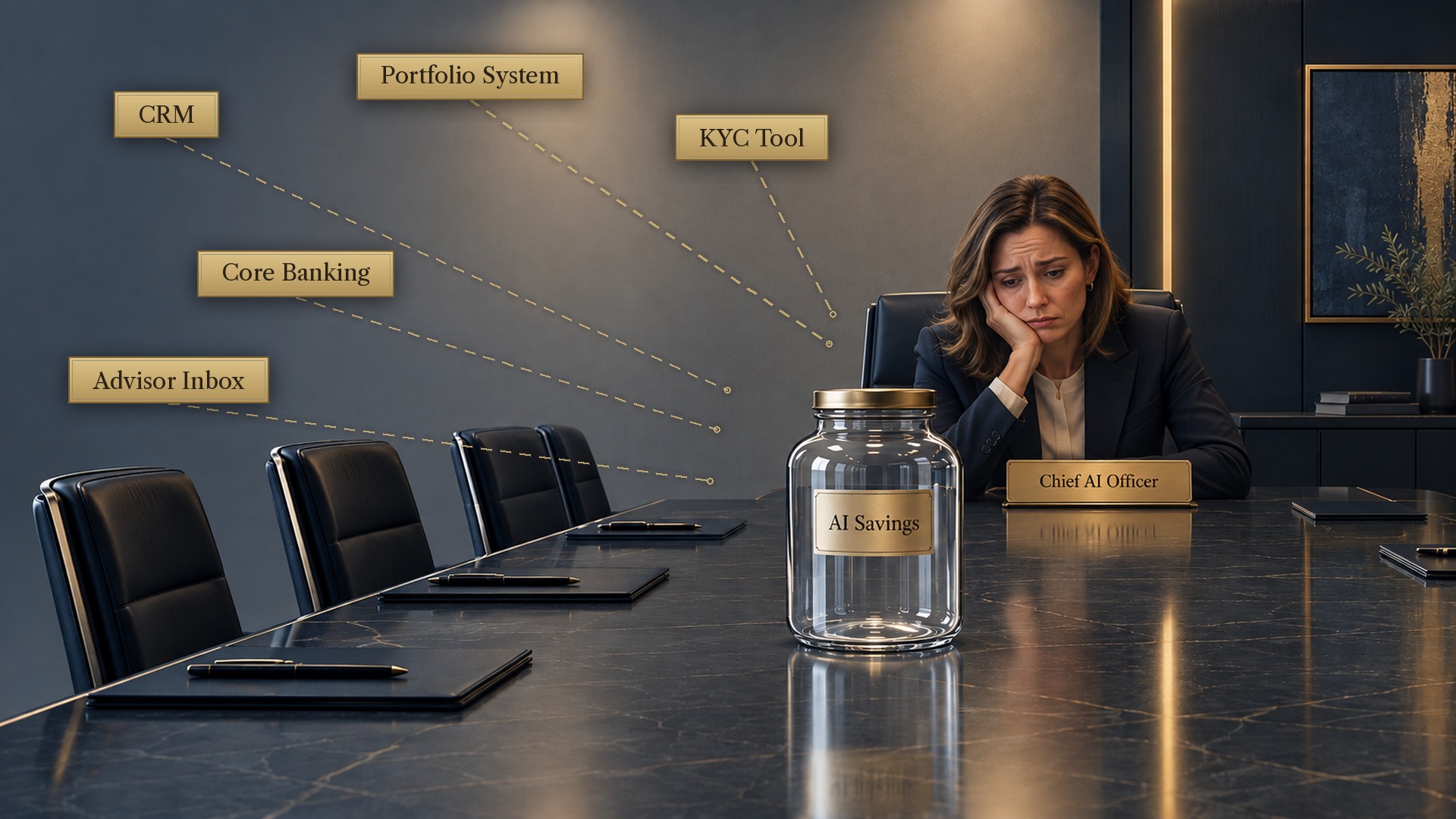
At a typical wealth manager, client details sit in the CRM. Positions sit in the portfolio management system. KYC sits in the compliance tool. Fees sit in core banking. The useful context sits in an advisor’s inbox.
The model inherits every disagreement between those systems. Someone has to reconcile the output before it reaches a client.
When the model is wrong, the human does the work twice.
That is where the savings go.
This is what Chief AI Officers are actually hired to fix. Citi framed its AI push as part of modernizing infrastructure and fixing long-running data management issues that drew regulatory scrutiny. HSBC paired its CAIO appointment with an expanded CTO remit to modernize core platforms and build a central AI platform.
The title says AI. The job description says plumbing.
Five Questions a Board Should Ask Before Counting on AI Savings
- Which P&L line moved? If the answer is “hours freed,” ask where the hours went: revenue, capacity, or coffee. Freed time only counts once it shows up as lower cost or higher revenue.
- Do the systems feeding the model agree with each other? If not, the savings are being spent on reconciliation.
- Who owns the client record, as opposed to the model? A CAIO who owns the AI but not the data owns the blame without the fix.
- What does the business case assume about the next model version? Validation describes the model you tested, not the one the vendor ships next quarter.
- Would Fitch’s mitigants hold for us? Scale, lower cost to service, usable proprietary data. Count how many you can evidence today.
Fitch gave wealth management five years of rating comfort. Most of it is borrowed against savings that have not arrived.
Frequently Asked Questions
Will AI Affect Wealth Manager Credit Ratings?
Not soon, according to Fitch. It does not expect sector-wide rating actions for private banks and wealth managers within five years. Under its adverse scenario, a typical issuer could face a Negative Outlook and a one-notch downgrade.
Why Aren’t Banks Seeing AI Cost Savings Yet?
Most use cases remain at proof-of-concept, and fragmented data forces humans to reconcile AI output. Savings appear once a P&L line actually moves.
What Does a Chief AI Officer Do at a Bank?
On paper, AI strategy and adoption. In practice, much of the job is fixing the data foundations that AI depends on.
What Is Fitch’s AI Stress Test?
A five-year scenario analysis scoring sectors from 0 to 100 on potential ratings impact under three adverse AI scenarios: over-investment, asset impairment and disruption.
Disclosure: This article was partially drafted by AI and reviewed by a human.
For more insights about what AI can or cannot do, check out my book “Artificial Stupelligence: The Hilarious Truth About AI”.
Subscribe here to be the first to receive my insights.


