

By Lynn Räbsamen, CFA | Advisory Board Member, CFA Institute | Author, Artificial Stupelligence
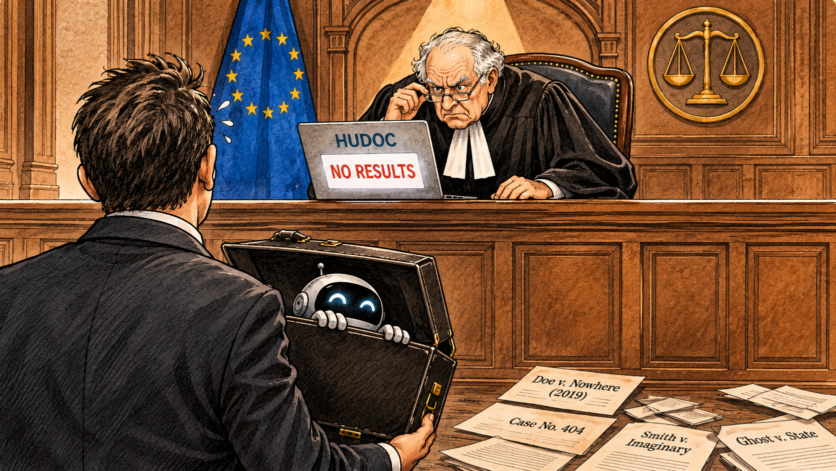
Courts don’t punish lawyers for using AI. They punish them for not checking it. On November 18, 2026, the European Court of Human Rights announced a two-year exclusion for a lawyer who filed AI-fabricated case law without verifying it in the court’s own database. The lesson reaches far beyond law. Anyone producing trusted content needs tiered review, automated checks, and one named owner per sign-off.
What Did Europe’s Human Rights Court Decide?
On November 18, 2026, the European Court of Human Rights announced that it had barred a Romanian lawyer from representing applicants before it for two years. His offense was filing case-law references that AI had generated and that turned out to be false.
Read the reasoning closely. The court did not sanction the use of AI. The lawyer admitted using AI tools, and that wasn’t the problem. The problem was that he didn’t check the output against HUDOC, the court’s own public case-law database. Many errors repeated themselves, and a simple search would have caught them. Some references were never checked at all.
The court didn’t ban the tool. It banned the shortcut.
Two details matter. The exclusion applied to one of the applicants’ two representatives, not both. And the decision doesn’t rule out his representation rights being restored later. Still, two years is a long time to explain to clients.
How Common Are AI Hallucinations in Court?
More common than anyone would like. Damien Charlotin, a Paris-based legal researcher, tracks court decisions worldwide that involve AI-fabricated material.
| Measure | Decisions |
|---|---|
| Worldwide, as of November 20, 2026 | 2,313 |
| United States, as of November 20, 2026 | 1,571 |
| United States, June 2026 | 1,116 |
That’s hundreds of new US decisions in about five months.
A caution about the numbers. Not every listed decision is a sanction, and many end with a warning. Many also involve people representing themselves, not lawyers. So this isn’t a count of disgraced professionals. It’s a count of courts having to stop and ask whether a cited case actually exists.
That question should never need asking. Today courts ask it several times a day.
Why Does This Keep Happening?
Because AI writes faster than humans read.
A model can produce a polished, confident, citation-heavy brief in a minute. Checking every reference properly takes hours. As output grows, review becomes the bottleneck. And under deadline pressure, bottlenecks get skipped.
The fake citations are also convincing. Legal citations follow strict formats, and AI is excellent at formats. It can produce something that looks exactly like a real case, without the inconvenience of the case existing. Put plainly, AI generates text that matches patterns, and that includes realistic but fictitious references.
“Have a human check everything” isn’t a strategy. It’s a wish.
Humans can’t keep up with the volume. The real question is what humans should check, and what the system should check for them.
How Should Organizations Verify AI Output?
This is the framework I use for any high-stakes content operation.
Decide What’s Non-Negotiable
Not all content carries the same risk. Giving everything the same scrutiny wastes reviewers on low-risk content and starves the high-risk work. Define the risk classes first. Then match the level of review to each one.
| Content | Risk Class | Review Level |
|---|---|---|
| Citation in a court filing | Non-negotiable | Automated check plus named human sign-off, every time |
| Client-facing research or reports | High | Automated checks plus expert review |
| Internal meeting summary | Low | Spot checks; errors get fixed at the next meeting |
A citation in a court filing must point to a real case that is still good law. No exceptions.
Build Verification Into the Tools
Some checks are mechanical. Machines should run them automatically, against authoritative sources, every time. That frees human judgment for what it’s actually good at.
| Machines Check | Humans Judge |
|---|---|
| Does this case exist? | Does the argument hold? |
| Is it still valid? | Does the conclusion follow? |
| Does this figure match the source? | Does something feel off? |
The ECHR case proves the point. A database lookup would have caught the errors. No legal genius required.
Give Every Sign-Off One Named Owner
At a large bank I worked with, a team in another country produced reports for portfolio managers in Zurich. The reports had errors. One portfolio manager spotted them and didn’t fix them. In his view, it wasn’t his job. He was right. It wasn’t anyone’s job, because nobody owned the final sign-off.
When everyone reviews, nobody is accountable.
AI makes this worse. The machine produces the draft, but a machine can’t be held accountable. If no human owns the result, nobody does. Every piece of high-stakes content needs one name on the approval. Not a team. A person.
Keep an Audit Trail
Record who or what produced each piece of content, and who approved it. When something goes wrong, and eventually something will, you want to know where the error came in. You also want to show a regulator, a client or a judge that a process existed and was followed.
What I Learned Deploying AI in Content Operations
At one of my previous firms, we built an LLM translation hub that cut translation time from days to hours. But we kept human review in the workflow, because speed was never the product. Quality was. A fast, wrong translation in an educational course isn’t an efficiency gain. It’s a liability with a delivery date.
In another firm, I was responsible for research and content products. There, accuracy was always the product. Clients didn’t pay for words. They paid for words they could trust.
The lesson carries over. AI changes how content gets made. It doesn’t change who answers for it.
What Happens to the Expert?
The expert’s job is shifting from writing everything to grounding and validating what AI writes. That changes how organizations should value and pay their experts. More on that in a future piece.
AI can draft the brief. It can’t sign it. That part still carries your name.
Frequently Asked Questions
Did the European Court of Human Rights Sanction a Lawyer for Using AI?
Not for using it. The court barred a lawyer for two years for failing to verify AI-generated case-law references against its HUDOC database. The decision was announced on November 18, 2026.
How Many Court Decisions Involve AI Hallucinations?
As of November 20, 2026, Damien Charlotin’s database lists 2,313 decisions worldwide, 1,571 of them in the US. Not all are sanctions, and many involve people representing themselves.
What Is an AI Hallucination in a Legal Filing?
It’s false content generated by AI, such as a citation to a case that doesn’t exist or a made-up quote from a real case.
How Can Organizations Reduce the Risk of AI Hallucinations?
Classify content by risk, automate mechanical checks against authoritative sources, assign one named owner to every sign-off, and keep an audit trail.
This article was partially drafted with AI, and reviewed and edited by a human.
For more insights about what AI can or cannot do, check out my book Artificial Stupelligence: The Hilarious Truth About AI.
Subscribe here to be the first to receive my insights.


