

By Lynn Räbsamen, CFA | Advisory Board Member, CFA Institute | Author, Artificial Stupelligence
In 2023, I asked a room of sharp finance and technology people what would change the world next. The most common answer was quantum computing. Not one person said generative AI. A few weeks later, ChatGPT became the fastest-growing consumer product in history, and quantum computing was still, as it had been for a decade, about five years away.
That is not a story about quantum computing.
It is a story about how confidently we get the future wrong.
The fever dream is a template, not a forecast
Every new technology triggers the same reflex. We take an early curve, assume it keeps bending upward forever, and arrive at a spectacular destination. In 2023, the destination was quantum supremacy. Today, ask the same room and the answer is unanimous: the next thing that changes everything is AGI, artificial general intelligence, machines that think like us, only better.
The confidence is total. The method is identical to the one that missed generative AI entirely.
The method never changes. Only the noun does.
There is a name for part of this. Amara’s Law: we overestimate the impact of a technology in the short run and underestimate it in the long run. True, and useful. But it is incomplete. The impact does not just arrive late. It arrives sideways. The revolution shows up wearing a different outfit than the one we were watching for, walks past us at the party, and we miss it because we are still staring at the door.
What fever dreams actually deliver
Here is the part the doom-and-hype cycle leaves out. Fever dreams are not a total loss. They rarely deliver the thing on the poster. They almost always deliver something adjacent, quieter, and more useful than anyone bothered to imagine.
I first mapped this graveyard of billion-dollar bets in an earlier piece on why most VC tech dreams crash.
Consider the track record again, this time not for what it cost, but for what it quietly left behind.
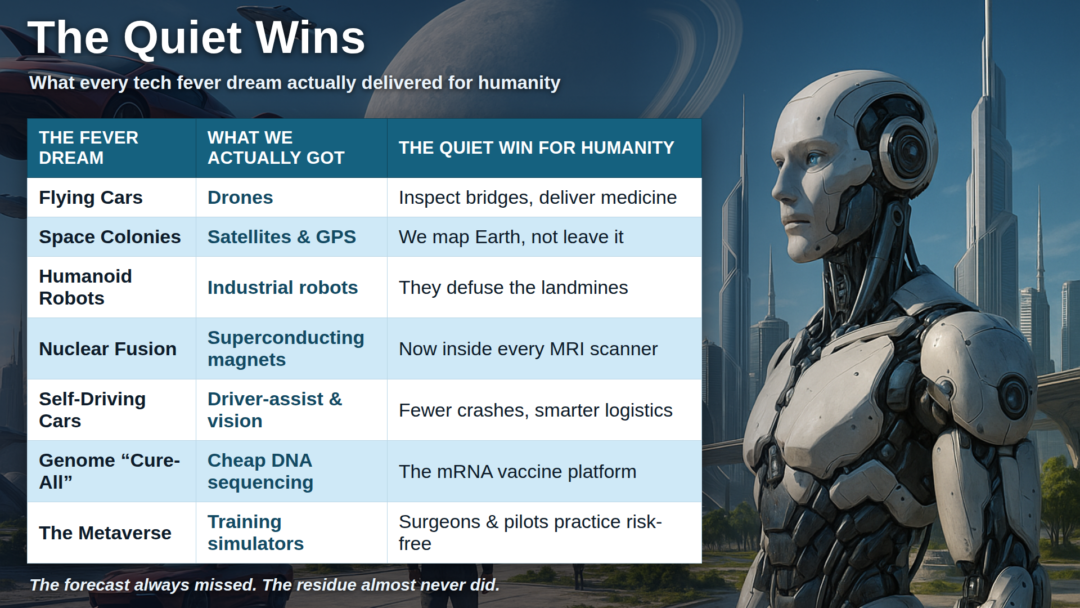
| The dream we were sold | What we actually got |
|---|---|
| Flying cars in every driveway | Drones that inspect bridges, map farmland, deliver medicine, and film weddings |
| Space colonization, cities on Mars | Satellites, GPS, and weather forecasting. We wanted to leave Earth. We got to see it clearly. |
| Humanoid robots to do our chores | Industrial robots that do what humans should not: welding, lifting, and defusing landmines |
| Nuclear fusion, limitless energy, always thirty years out | Superconducting magnets, now sitting inside every MRI scanner in every hospital |
| Fully self-driving cars | Automatic braking, lane-keeping, and the computer vision stack now quietly running logistics and mapping |
| The Human Genome Project to cure every disease | Cheap, fast DNA sequencing and the platform that, decades later, produced mRNA vaccines in record time |
| The metaverse, a life lived in VR | High-fidelity simulators that train surgeons, pilots, and factory crews where mistakes cost nothing |
The dream was a machine that acts human. The gift, again and again, was a machine that handles the inhuman.
Seven fever dreams. Zero delivered as promised. All seven left behind something that genuinely improved human life. The forecast was wrong every time. The residue was valuable almost every time.
Which brings us, inevitably, to AGI
When generative AI arrived, we did what we always do. We extrapolated. A chatbot that writes a passable email today becomes, on the whiteboard, a superintelligence that runs the economy by Thursday.
Maybe. I would not bet a balance sheet on it.
Because the useful thing generative AI actually brought is already here, and it is not general intelligence. It is the ability to handle enormous volumes of information and data, and to produce high-quality, coherent output at a speed no human can match. That is not a small thing. It is an extraordinary thing. It is also not AGI, any more than a drone is a flying car.
The useful thing is already flying. We are just looking up, waiting for the flying car.
The part that matters for anyone allocating capital
This is where the pattern stops being a fun history lesson and starts being a discipline.
If the impact of a technology reliably lands somewhere other than the forecast, then betting the firm on the forecast is not conviction. It is a coin toss with a good narrative attached.
The disciplined move is the one every CFA charterholder already knows by another name: margin of safety, and optionality.
Fund the capability you can actually verify today. Not the future you were sold.
Keep the option on the upside open. Do not mortgage the present for a destination nobody has ever once predicted correctly.
The market just ran this experiment in public. 23-year-old Leopold Aschenbrenner built a hedge fund on the thesis of his own 165-page essay, AGI by 2027, without prior investment experience. In my earlier piece, I warned it would fail. In July 2026, it did. Situational Awareness lost roughly 67 percent in a single month, offloaded its public portfolio to Citadel in a fire sale, and JPMorgan cut off its lending.
For a board being told that AGI is coming and the firm must prepare now, the sharper question is not “how do we get ready for the singularity.” It is “what does this technology verifiably do inside our workflows this quarter, and what could go wrong.” Govern the drone. The flying car does not need a risk policy yet, because it does not exist yet.
A better question
So perhaps we are asking the wrong thing at these conferences. “What is the next big thing that will revolutionize the world” is a machine for manufacturing fever dreams. It rewards the boldest extrapolation and punishes nobody when the extrapolation fails, because by then the room has moved on to the next noun.
The better question is quieter and far more useful. Not what will change everything. But what genuinely useful thing did this actually leave behind for us, and how can we leverage it. The first question makes headlines. The second one makes decisions.
Nobody saw ChatGPT coming. Everybody sees AGI coming. History suggests that is precisely the tell.
This article was partially drafted with AI, and reviewed and edited by a human.
For more insights about what AI can or cannot do, check out my book “Artificial Stupelligence: The Hilarious Truth About AI”.
Subscribe here to be the first to receive my insights.


