
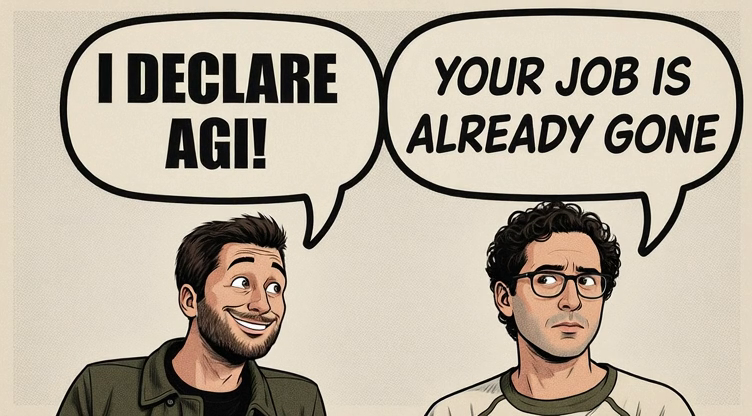

Whenever AI leaders need money, they cry doom. AGI looms! White-collar jobs evaporate! The end is nigh! Or so the script goes. Then, poof: record funding rounds materialize. Coincidence? Hardly. The pattern is as polished as a SoftBank term sheet. Companies buying the hype fired en masse, only being forced to rehire after flops. Why? Harvard Business Review reveals: layoffs were not driven by AI’s current performance, but by its future (assumed) potential.
Over 98% of AI-attributed cuts stem from “expected future potential,” not evidence of replacement.
OpenAI: From AGI Visions to Record Raises
Sam Altman knows how to set the stage. In a late December 2024 livestream, he laid out a concrete path to AGI—AI systems acting as research interns by September 2026, achieving full superintelligence by March 2028. The message landed. Investors saw not just promise, but inevitability.
Just three months later, on March 31, 2025, OpenAI closed a staggering $40 billion funding round. SoftBank led with $30 billion, marking the largest private tech round in history. Microsoft and others followed.
The momentum built further. In July 2025, Altman warned at a Federal Reserve conference that entire job categories—like customer support—would disappear entirely due to AI.
Today, OpenAI burns through $14 billion in 2026 alone on massive compute projects like Stargate. A new round targeting up to $100 billion is in advanced talks for a Q1 2026 close, potentially valuing the company at $750-830 billion. Nvidia, SoftBank, and Middle Eastern funds are circling. Those mid-2025 job warnings? They laid the perfect groundwork, six months ahead.
| Date | Event Type | Details |
|---|---|---|
| Late Dec 2024 | AGI Hype | Livestream: AGI timeline (interns 2026, full AGI 2028) – Sam Altman |
| Mar 2025 | Funding | $40B closed (SoftBank $30B lead, largest private tech round) |
| Jul 2025 | Job Doom | Entire job categories disappear (Fed confab) – Sam Altman |
| Q1 2026 (est.) | Funding* | Up to $100B targeted (Nvidia/SoftBank/Middle East; $750-830B valuation) |
*In advanced talks as of February 2026; driven by extreme cash burn.
Anthropic: A Relentless Cycle of Warnings and Windfalls
Anthropic’s Dario Amodei struck first. In June 2024, he told The Times: “By next year, AI could be smarter than all humans”. Spoiler: the prediction fell far short of reality in 2025.
In November 2024, he forecasted AGI arriving by 2026 or 2027—”unless something goes wrong.” Simple extrapolations of current trends made it sound all but certain.
By March 2025, Anthropic’s Series E round closed at a $61.5 billion valuation, led by Lightspeed Venture Partners with over $1 billion raised.
Amodei turned up the volume in May 2025: AI would eliminate half of all entry-level white-collar jobs within one to five years, potentially driving unemployment to 10-20%. Four months later, on September 2, 2025, a $13 billion Series F round closed at $183 billion valuation. Iconiq, Fidelity, and Lightspeed jumped in.
The warnings intensified. In December 2025, he repeated the 50% white-collar wipeout prediction. Then at Davos in January 2026, Amodei declared software engineering jobs automatable end-to-end within 6-12 months. Result? February 2026’s Series G: $30 billion raised at $380 billion post-money valuation.
| Date | Event Type | Details |
|---|---|---|
| Nov 2024 | AGI Hype | “AGI 2026/2027 unless something goes wrong” – Dario Amodei |
| Mar 2025 | Funding | Series E: $61.5B valuation (Lightspeed lead; >$1B raised) |
| May 2025 | Job Doom | 50% entry-level white-collar gone in 1-5 years – Dario Amodei |
| Sep 2025 | Funding | Series F: $13B at $183B valuation (Iconiq/Fidelity/Lightspeed) |
| Dec 2025 | Job Doom | 50% white-collar wipeout repeat – Dario Amodei |
| Jan 2026 | Job Doom | Software engineering automatable in 6-12 months (Davos) – Dario Amodei |
| Feb 2026 | Funding | Series G: $30B at $380B post-money valuation |
The Billion-Dollar Flywheel—and Its Reality Check
The pitch is elegant: Hype AGI to spark FOMO among investors. Amplify job doom to sell the urgency. Every company will deploy AI for massive cost savings, firing humans en masse. Then AGI lands—boom. Anyone refusing to pay for their models gets crushed. Valuations soar to the stratosphere as VCs bet on monopoly economics.
Both OpenAI and Anthropic fuel this narrative perfectly, timing warnings three to six months before closes. Model progress underpins it—Claude sharpens, o1 deliberates. Compute empires demand the cash: Stargate superclusters, endless GPUs. Media megaphones the drama. Checks clear.
Yet here’s the delicious irony.
A Harvard Business Review survey of 1,006 global executives in December 2025 found companies are slashing headcount based on AI’s potential—not its performance.
Layoffs cite what AI might do someday, not current reality. IBM data confirms the gap: Only 1 in 4 AI projects deliver promised ROI; just 16% scale enterprise-wide. Those who fired for instant savings? Many rehired after productivity tanked.
History offers clearer lessons on AI’s real-world trajectory. Airplane autopilots didn’t decimate human pilots. AI imaging tools haven’t replaced radiologists. Quite the opposite: salaries in these fields climb steadily with tech adoption. Why? Tools augment expertise, refine outputs, and boost productivity.
Productivity Boosts Without Job Losses
AI so far also hasn’t decimated employees in accounting, auditing, or law—Fortune articles from June and July 2025 detail thriving professions where tools supercharge workflows. Lawyers now summarize cases and draft memos in minutes, not hours, per the June piece; accountants and auditors use AI for rapid transaction screening and anomaly detection, as the July article notes. Firms report efficiency gains, with no widespread layoffs. Instead, staff pivot to higher-value strategy and client advisory, billing more effectively.
AI replaces tasks, not humans. Consumers win with superior, faster service.
Overstated Warnings
AI CEOs like Altman and Amodei could highlight these upsides. Instead, they dial up doom, overlooking how tasks shift while humans oversee. It seems FOMO opens checkbooks faster than tales of quiet improvement.
For more insights about what AI can or cannot do, check out my book “Artificial Stupelligence: The Hilarious Truth About AI”.


