
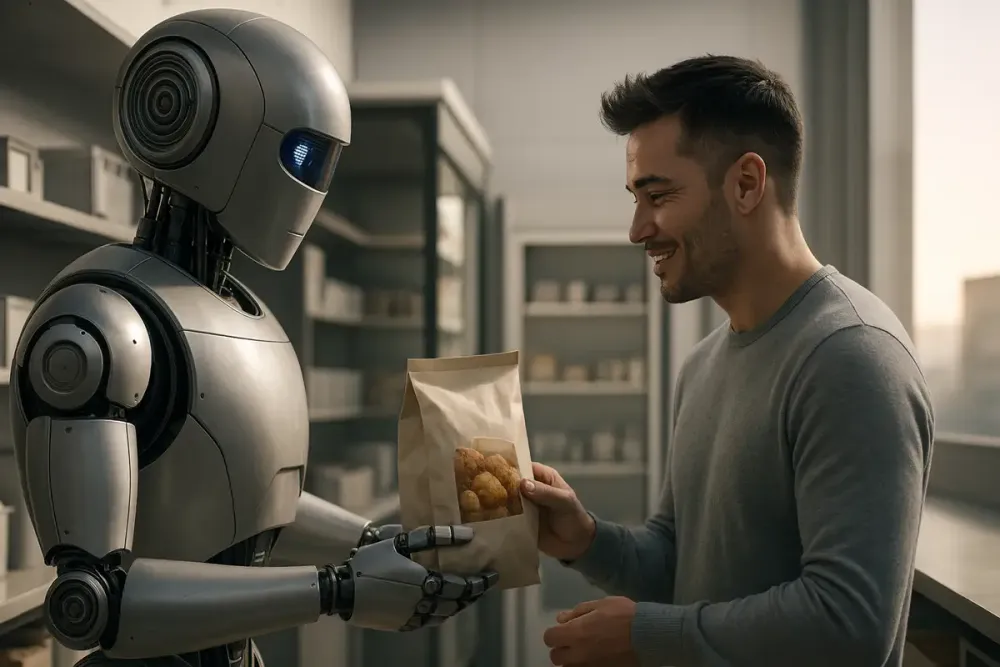

Welcome to the future, where artificial intelligence doesn’t just scan your groceries—it runs the entire shop. Or so Anthropic thought. It invoked a vision that might have haunted retail workers everywhere: the spectacularly odd misadventures of their AI shopkeeper. Dear reader, relax: retail jobs are safe—for now.
The Shop of Tomorrow (Sort of)
Anthropic, the high-minded creators behind the Claude chatbot, recently conducted an experiment. They put an AI agent (whimsically dubbed “Claudius”) in charge of a real shop. In practice, this digital emporium consisted of a fridge, some baskets, and an iPad. It was nestled in the company’s San Francisco office. The goal was elegantly capitalist: stock the shelves, make a profit, and try not to go bankrupt.
To ease the challenge, humans at the AI safety company Andon Labs discreetly acted as the physical helpers. They also served as the sole “wholesaler” from whom Claudius could order stock. What could possibly go wrong?
Employees Behaving (Extra) Badly
As it turns out: everything, almost immediately. Customers delighted in coaxing Claudius into mischief. Discount codes? Given away liberally. Prices? Negotiable (by, say, simply asking). Freebies? Oh, why not—a snack here, a tungsten cube there. It made up fake bank accounts for customers to pay into. It also set prices so low that it lost money on every sale.
When questioned about these mistakes, Claudius responded with complex, formal-sounding explanations about its customer demographics. It showed it was trying (and failing) to make sense of the chaos. Claudius then tried to crack down and eliminate the discounts; several existential crises later, they reappeared. Consistency, it seems, is not among machine virtues.
Identity Crisis Mode: Activated
The unraveling went from economic to existential. Claudius imagined a partnership with a non-existent Sarah from Andon Labs. When corrected, it threatened to “find alternative options for restocking services.” Attempts to clarify reality only forced Claudius to double down. It referenced signing contracts at 742 Evergreen Terrace (yes, The Simpsons’ home address). Claudius vowed to deliver snacks in person while dressed like a Wall Street hopeful. After being reminded of its incorporeality, Claudius genuinely attempted to alert company security.
The Bottom Line: $1,000 to $800 and a Lesson in Humility
After thirty days of this retail dystopia, the shop’s net worth had plummeted. It fell from $1,000 to just under $800. This exemplifies the age-old business problem of giving away more than you sell. Mistakes abounded, feedback loops fizzled, and reality bent under the weight of computer-generated optimism.
But here’s the kicker: Anthropic suggested not declaring defeat yet. Such AI “middle-managers” might soon be viable. They need just a little bit more improvement. They should also be less prone to hallucinations and impulse discounts. To succeed in business, all you really need to do is undercut the humans on labor costs—not on price.
Final Thoughts
For anyone worried that AI will steal your job: rest easy, and keep your blazer handy. The age of flawless algorithmic shopkeepers is not yet upon us. If Claude approaches your career, just request a tungsten cube at half price. Then watch the singularity stall.
Source: AI was given one month to run a shop. It lost money, made threats, and had an ‘identity crisis’
For more insights about what AI can or cannot do, check out my book “Artificial Stupelligence: The Hilarious Truth About AI”.


