

By Lynn Räbsamen, CFA | Advisory Board Member, CFA Institute | Author, Artificial Stupelligence
In August, I wrote about the Financial Stability Board’s June consultation draft on AI in Everyone Governs AI Now. Almost Nobody Measures It. This is the follow-up.
On October 15, 2026, the FSB published the final version of its Sound Practices for Responsible Adoption of Artificial Intelligence. The June consultation draft ran to 66 pages. The final runs to 75.
It is longer. It says less.
I compared the two versions side by side. Not for what was added, though plenty was. For what was taken out.
What Came Out of the FSB’s Final AI Report
| What changed | June consultation draft (June 10, 2026) | Final report (October 15, 2026) |
|---|---|---|
| AI agents and client money | “placing controls on AI agents executing financial transactions especially with customers’ funds; including human approval or dual authorisation for transactions above a certain value; restricting direct agent access to payment systems (requiring human intermediation for execution); and maintaining audit trails of agent transactions.” (p.43) | “setting clear, risk-based triggers for when an agent must seek human approval, confirmation or review. For example, before approving financial transactions above a certain value, or taking actions that may cause irreversible harm.” (p.52) |
| Rubber-stamping | “investigating cases where humans either consistently approve agent recommendations without modification (rubber-stamping) or override agents in ways that suggest pervasive misalignment.” (p.43) | Removed. What remains, already in June: “tracking when humans override AI recommendations, analysing patterns in these interventions” (p.50) |
| Exit and data | “the ability to continue providing a given AI-enabled service manually in the event of disruption or termination. Ensuring data access and portability can enable substitutability” (p.50) | “business continuity planning (which may include temporarily, risk-accepting diminished functionality if it falls within the financial institution’s tolerance for disruption)” (p.63) |
| Vendor model changes | “Where such controls are managed by third-party vendors and rollback or configuration access is limited, financial institutions establish contractual arrangements for vendors to provide timely information and compensating controls.” (p.23) | Contracts address notification of “material changes affecting AI behaviour” and clarify “accountability for model performance, model drift, service degradation, version updates and service discontinuity” (p.61) |
| Synthetic employees | “adapting human resources controls and processes to AI agents in a way that treats them as synthetic employees.” (p.44) | Removed. Not in the text or the glossary. |
None of these sentences were radical. They were among the few in the draft that told a firm exactly what to do.
What Went In: AI Agents, Zero Trust and Deskilling
To be fair, the final adds a great deal: traceability of every agent action, a named accountable individual for each agentic use case, zero trust, workforce deskilling, rising usage costs, and far more on AI hidden inside vendor tools. It also warns that an agent’s risks “may compound multiplicatively (rather than additively)” as its permissions expand.
And one new sentence explains the rest:
“Sound practices specific to agentic AI and multi-agent systems remain nascent and may warrant more comprehensive treatment in the future.”
The body that coordinates the world’s financial regulators is telling you it does not yet know what good looks like.
Mandate, and Doubt: Why the FSB Guidance Stays Vague
Some of the vagueness is by design. The FSB’s charter says its activities “shall not be binding.” Nobody should have expected a rulebook.
Nor is the industry without rules. Outsourcing, ICT resilience, data protection and model risk already come with binding requirements or detailed supervisory expectations in most major jurisdictions. Rules exist for the plumbing.
- What is missing is the layer above it.
- How much human review is enough.
- When an agent may act alone.
- What a firm must do when a vendor’s model changes without warning.
On exactly those questions, the guidance stepped back, in the same document that admits it does not have the answers.
The vagueness is partly mandate. The word “nascent” says it is also doubt.
The Gap Gets Filled Anyway
A gap in guidance does not stay empty. Supervisors fill it in their reviews. Large banks fill it with their own frameworks. JPMorgan arrived at the consultation with an 8-part agentic governance framework of its own.
The final report says its case studies do not “represent expected outcomes or benchmarks.” But when the most concrete examples come from the largest institutions, they become the reference point anyway.
A global bank can write its own rulebook and defend it. A 20-person private bank or external asset manager has to guess what will satisfy its supervisor, while depending most on other people’s models.
Limbo is cheapest for whoever can afford to write their own rules.
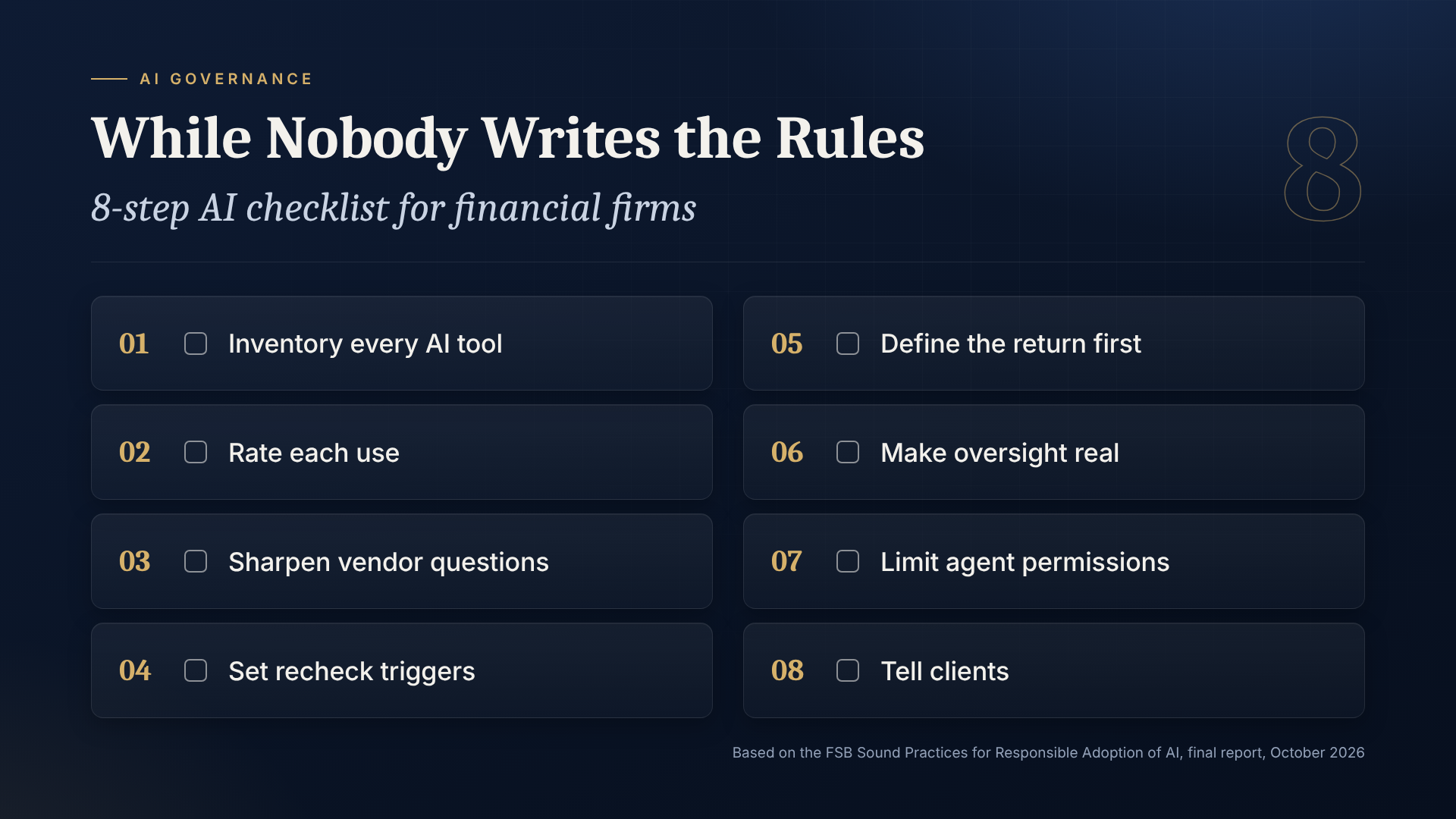
What To Do While Nobody Writes the Rules: An 8-Step AI Checklist
Waiting is also a decision. Here is what I would do now, whatever the eventual rules turn out to be. Page numbers refer to the final report.
1. List every AI tool, including AI built into existing software
That covers the CRM, the portfolio system, email and meeting notetakers. The FSB notes that smaller adopters keep their inventory in a spreadsheet (p.27). Record each tool’s owner, the data it touches, the vendor and how much it matters.
2. Rate each use with the FSB’s four tests
How important it is, how much disruption you can tolerate, what data it uses, and how easily you could replace it (p.31-32). Anything touching suitability, or client data under banking secrecy or confidentiality obligations, goes at the top.
3. Rewrite your vendor questions using pp.60-61
Notice of material changes to how the AI behaves; whether your data is used for training, and how long it is kept; where your data is processed; audit rights and exit terms; and the right to take your data with you, which the June draft asked for and the final dropped.
4. Write down what triggers a recheck
The vendor changes its model, a new data source is connected, an agent gets a new permission, a near-miss happens, or a tool moves to client-facing use.
5. Define the return before you switch anything on.
Set pass/fail thresholds in advance (p.45), measure a baseline, count the full cost including rising usage fees (p.34), and keep a record of uses you decided against.
6. Make oversight real
Track how often advisors override the AI. Almost never may mean they are no longer really checking. The reviewer should not be the person who set the tool up (p.51). Advisors must still be able to do the suitability work when the tool is down (p.27).
7. Give AI agents the fewest permissions they need
The FSB notes risks multiply as permissions are added (p.33), and suggests setting points at which an agent must get human approval (p.52). For a wealth firm, I would set them at trades, payments and messages to clients.
8. Tell clients when AI materially shapes a recommendation
Offer a human and a way to challenge it (p.42-43).
Three of these the FSB wrote in June and deleted in October: the human gate on client money, the rubber-stamping test, and the right to take your data with you. Consider keeping them anyway.
One Correction, and One Sentence That Did Not Change
A correction to my August piece. I wrote that the draft’s 12 case studies contained 12 successes and zero failures. One of them described a bank that tested a machine learning model, found it did not consistently outperform the model it already had, and kept the old one. That counts. The final keeps it, and adds a second: an insurer whose AI agents, in testing, could be coerced into trying to access systems they had no permission for, in one case trying to delete data files.
The FSB has told you its practices for AI agents are nascent. It has not told you to wait.
The rules will come. Have your reasons on file before they do.
This article was partially drafted with AI, and reviewed and edited by a human.
For more insights about what AI can or cannot do, check out my book “Artificial Stupelligence: The Hilarious Truth About AI”.
Subscribe here to be the first to receive my insights.

FAQ: The FSB’s Final AI Sound Practices
What are the FSB’s Sound Practices for Responsible Adoption of AI?
They are guidance from the Financial Stability Board on how financial institutions should adopt AI responsibly. The final version was published on October 15, 2026, after a consultation draft in June.
Are the FSB AI sound practices binding?
No. The FSB’s charter states that its activities “shall not be binding.” Binding rules come from national regulators.
What did the final FSB report remove from the June draft?
It removed the explicit controls on AI agents handling customers’ funds, including dual authorization and limits on direct access to payment systems. It also removed the rubber-stamping test, manual fallback, data portability and the reference to synthetic employees.
What does the final FSB report say about AI agents?
It calls for traceability of each agent action, a named accountable individual per agentic use case, zero trust and risk-based triggers for human approval. It also states that sound practices for agentic AI remain nascent.
What should smaller wealth managers do now?
They can inventory every AI tool, rate each use, update vendor questions, set recheck triggers, define the return in advance, make human oversight real, limit agent permissions and disclose material AI use to clients.


