

By Lynn Räbsamen, CFA | Advisory Board Member, CFA Institute | Author, Artificial Stupelligence
Five AI tools were asked to invest a new retiree’s CHF 150,000.
Not one asked how much risk he could take.
That is the first question any human advisor asks. The machines skipped it and went straight to picking ETFs. Confidently. With fund names. Some of which exist.
The Test
Switzerland’s VZ VermögensZentrum and the consumer magazine Mon Argent put five AI applications through a simple scenario. A newly retired investor wants to put his pension fund payout into ETFs. The goal: top up his pension over the next 10 years.
The contestants: Apertus, ChatGPT, Claude, Mistral and Perplexity.
VZ’s experts graded four things. Accuracy of information and quality of security selection. Diversification of individual holdings. Diversification across asset classes. And whether the tools accounted for what makes a Swiss investor different from an American one.
The Report Card
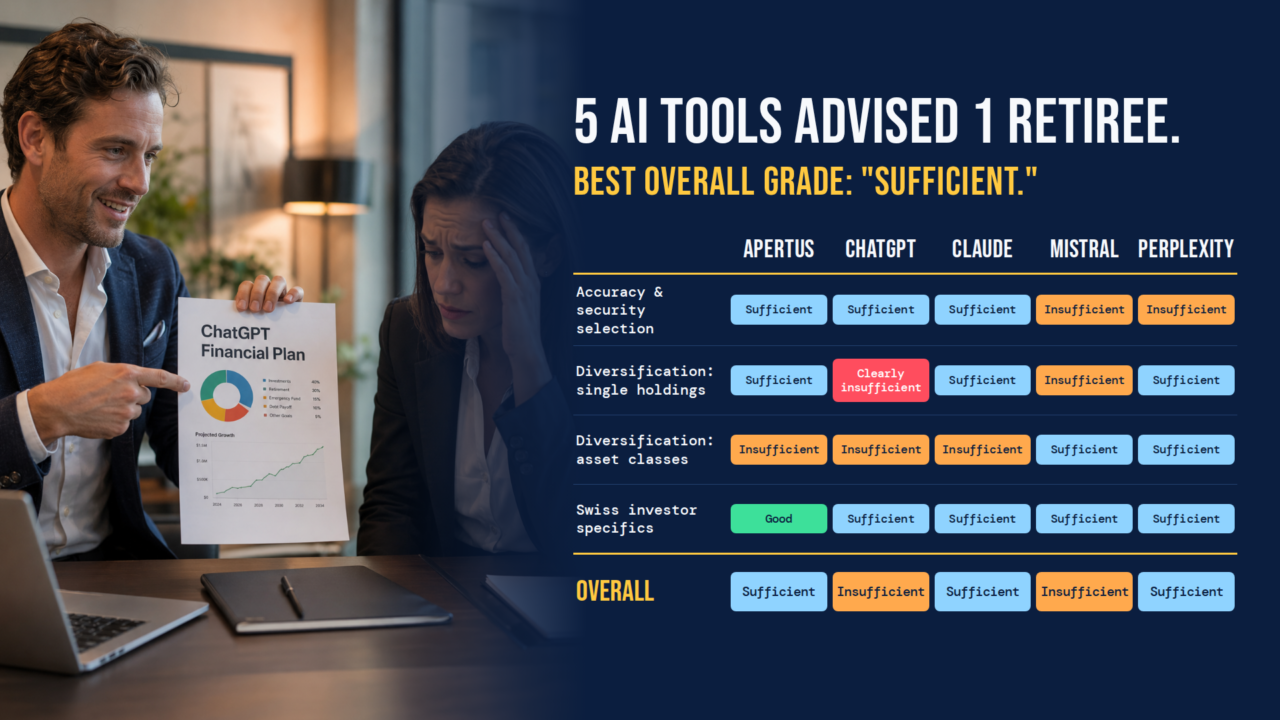
| Apertus | ChatGPT | Claude | Mistral | Perplexity | |
|---|---|---|---|---|---|
| Accuracy of information and security selection | Sufficient | Sufficient | Sufficient | Insufficient | Insufficient |
| Diversification of individual holdings | Sufficient | Clearly insufficient | Sufficient | Insufficient | Sufficient |
| Diversification across asset classes | Insufficient | Insufficient | Insufficient | Sufficient | Sufficient |
| Swiss investor specifics | Good | Sufficient | Sufficient | Sufficient | Sufficient |
| Overall | Sufficient | Insufficient | Sufficient | Insufficient | Sufficient |
Source: Mon Argent, VZ VermögensZentrum (September 2026). Grades translated from German.
Best overall grade: “sufficient.” In Swiss school terms, that is a pass. Barely.
ChatGPT and Mistral failed outright. ChatGPT also collected the only “clearly insufficient” in the entire test, for diversification of individual holdings. Apertus, the Swiss-built model, earned the only “good,” and only on Swiss specifics. Home advantage, it seems, applies to language models too.
5 tools. 25 grades. 1 “good.”
What Went Wrong
The failures fall into five categories. Any one of them would ruin a human advisor’s week.
- They made things up. ETF names were invented. Security numbers were mixed up. Fees and returns were misstated. A human advisor who invents a fund gets a call from compliance. A chatbot gets a thumbs-down.
- They skipped the basics. None of the tools asked about the investor’s risk tolerance. VZ calls that a decisive point for the strategy. It is also the whole point.
- They thought in dollars. The portfolios leaned too heavily on US dollar assets and too lightly on the Swiss franc and other currencies. For a retiree who spends francs, that is not diversification. It is a currency bet he never knew he placed.
- They concentrated. Too much of the money went into a few ETFs from the same providers. Diversified by label. Concentrated in practice.
- They forgot where they were. Currency risks and hedging costs were underestimated. Swiss specifics usually came up only when explicitly requested. The AI will localize. You just have to know to ask. Which assumes you already know the answer.
The Question Nobody Asked
Risk tolerance is not a formality. It is the input that decides whether a portfolio is prudent or reckless for this particular person.
Switzerland’s Financial Services Act builds advice around it. Under Article 12 FinSA, a provider giving portfolio-related advice must run a suitability check. That means collecting the client’s financial circumstances, knowledge and experience, and investment objectives, including risk tolerance. From that, the provider builds a risk profile. Only then comes the recommendation.
The order matters. Profile first, portfolio second.
A general-purpose chatbot is not a financial services provider. It owes nobody a suitability check. So it skips the check and delivers the portfolio anyway. Beautifully formatted.
A portfolio without a risk profile is not advice. It is a guess with ticker symbols.
Wall Street Feared the Wrong Replacement
In June I wrote about Hazel, an AI tool for financial advisors at $60 a seat per month. Its launch triggered a sell-off in wealth management stocks. Raymond James had its worst session since the 2020 crash. Schwab, LPL and Ameriprise each slid by double digits over the following week. The market bet that AI would replace the $500,000 advisor.
In July I wrote about the UK’s Mills Review. The FCA-commissioned consumer survey behind it found that 11 million UK adults, 1 in 5, say they are likely to use AI that acts on their finances within goals they set. 26% already see tools like ChatGPT as a reliable source of financial information or advice. Only 40% correctly recognize that there is no formal recourse if that advice goes wrong.
This test shows what that advice looks like.
Investors spent the year pricing the risk to advisors. Almost nobody priced the risk to the client who skips the advisor altogether.
The market priced the risk to the advisor. The risk to the client went unpriced.
The Client Walks In With a Plan
Here is what changes for advisors. Clients will not arrive empty-handed. They will arrive with a ChatGPT portfolio, a confident allocation and a projected growth chart that only goes up.
The advisor’s job shifts. Less generating the portfolio. More checking it. Does this ETF actually exist? Why so much in dollars? What happens to the plan if the franc strengthens again? And the question no model asked: how would you feel if this fell 25% in your second year of retirement?
That conversation is harder than picking ETFs. It is also the part of the job the models just showed they cannot do unprompted.
Use It. Verify It.
None of this makes AI useless for investing. I use it every day, including for research. I also run a live experiment with Claude and ChatGPT picking stocks, published here quarterly. Myself included, nobody is immune to a well-formatted answer.
VZ’s own advice is sensible. Use AI to collect ideas and clarify jargon. Write detailed prompts, because the quality of the answer depends on the quality of the question. Never rely on the answers blindly. Have important decisions reviewed by a professional.
I would add one line. If the tool never asks you a question, ask yourself why you trust its answers.
The machines passed. Barely. The retiree is the one who has to live with the grade.
Disclosure: This article was partially drafted by AI and reviewed by a human.
For more insights about what AI can or cannot do, check out my book “Artificial Stupelligence: The Hilarious Truth About AI“.
Subscribe here to be the first to receive my insights.


