

By Lynn Räbsamen, CFA | Advisory Board Member, CFA Institute | Author, Artificial Stupelligence
Wall Street spent three years piloting AI. This week, the lab it was piloting with started selling the finished product.
On September 10, OpenAI launched ChatGPT for Financial Services, built with Morgan Stanley and Evercore as design partners. Company research, financial models, pitchbooks. These are not vendors hoping banks will come. These are banks that helped build the thing.
Then, the same day, OpenAI paused new sign-ups to its $200 tier because demand had strained its systems. The message underneath was not an apology. It was: look how badly everyone wants this.
Ship the product, then announce you are running short of what it runs on. Scarcity is the oldest demand signal in commerce. It reads as validation rather than failure, and it costs nothing to announce.
I cannot see inside OpenAI’s capacity planning and will not pretend I can. But a shortage disclosed on launch day, by the party selling the product, deserved more skepticism than it got.
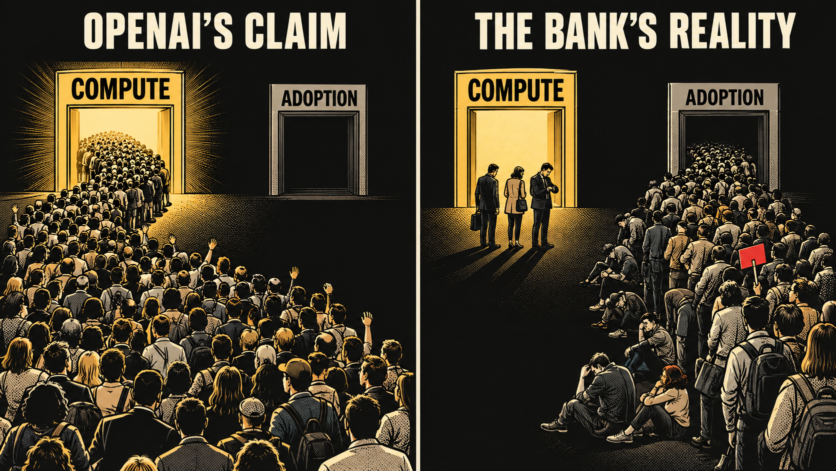
It also pointed the whole market at the wrong constraint.
What stands between a bank and a return on AI is not compute. It is everything between the license and the desk.
The demand is not the interesting part anymore
For three years, the honest answer to “is finance actually adopting AI” was a shrug and a slide deck. That answer has expired.
Two labs now sell directly into the workflows that data vendors and point solutions used to own. Design partners are the buyers themselves. Procurement has replaced experimentation, and the budgets behind it are not pilot budgets.
The banks are not in the pilot phase anymore. They are in the procurement phase.
Which makes the next question the expensive one. Everyone can buy it. Almost nobody can use it.
The scarcity everyone read wrong
Set the timing aside for a moment and take the shortage entirely at face value. It still does not mean what the coverage said it meant.
The headlines wrote themselves. Compute is the constraint. The frontier is rationed. Get in line.
Now look at what stayed open. The API. The business tiers. Every lower plan. What closed was new subscriptions to one premium consumer SKU.
That is a very specific shortage. It is not a shortage of the capability banks are buying.
The waiting list was for a subscription tier. It was never for the work.
Most of the work does not need the frontier
There is a quieter reason the compute story misleads. The tasks that actually consume a wealth manager’s week are not hard.
Meeting notes. Suitability checks. Document retrieval. Data reconciliation. First drafts of client correspondence. Fee queries. These are repetitive, bounded and structurally dull. They do not require the most expensive reasoning model on the market. They require the same output twice.
NVIDIA’s research group made this case directly in its 2025 paper arguing that small language models are the future of agentic AI, estimating that serving a 7-billion-parameter model is roughly 10 to 30 times cheaper than a frontier-scale model on exactly this kind of narrow, repetitive work.
The frontier matters for the genuinely open-ended problems. It is not where the volume is.
Nobody needs a frontier model to reconcile a spreadsheet. They need it done the same way twice.
So if capacity is not the bottleneck, and model size is not the bottleneck, what is?
Three bottlenecks that do not show up in a license fee
Workflow, not access
A license grants access. It does not grant use.
When I was running operations, the pattern was consistent and slightly humiliating. Tools we had paid for sat unopened because they lived one tab away from where the work happened. The adoption number that mattered was never how many seats we bought. It was whether anyone reached for it at 8:40 on a Tuesday, under time pressure, with a client waiting.
AI that requires someone to leave their workflow, remember it exists and decide to try it will lose to the existing habit. Every time.
Judgment is the scarce skill
Machine output arrives fluent, formatted and confident. That is the product working as designed. It is also the problem.
The scarce person in a bank is not the one who can write a clever prompt. It is the one who reads a generated valuation and knows which number to check, which assumption is doing the heavy lifting, and when the confident tone is covering a gap. That is professional judgment, and it does not transfer from the tool.
Most training budgets are pointed at prompt technique. Prompt technique has a shelf life of about one model release. Judgment does not.
There is a second-order version of this that boards should think about now. If the analyst work goes, so does the mechanism that taught analysts what a deal is. Repetition was tedious, and it was also the apprenticeship. No one has put a number on removing it.
Governance that survives an examiner
Every firm has an AI policy. Very few have a reconstructible trail.
FINMA said this plainly in Guidance 08/2024, flagging explainability, accountability and third-party dependency as the live risks in supervised institutions. The FSB’s sound practices point the same way on third-party and lifecycle risk. None of that is satisfied by a PDF.
What satisfies it is duller. Logs that show which model produced which output, on what data, at what time. Entitlements that hold when a model is hosted on a vendor’s infrastructure rather than yours. A named human who owned the decision. The ability, eighteen months later, to reconstruct why a client got that recommendation and not another one.
That work is unglamorous, it is expensive, and it is the part that no launch event covers.
Capacity is a supplier problem. Adoption is entirely yours.
The question for the board
The board question is not which model to license. That question resolves itself, and it resolves the same way for your competitors.
Every firm on the design-partner list can have the same capability by Monday. So can every firm that was not on it. The variance in what any of them gets from it sits entirely on the implementation side: whether it reaches the workflow, whether the people using it can tell good output from plausible output, and whether the resulting decisions survive a supervisor asking how they were made.
None of that is a procurement line item. All of it is where the return is.
The compute shortage will clear in a quarter or two. The queue inside your own building has nobody counting it.
This article was partially drafted with AI, and reviewed and edited by a human.
For more insights about what AI can or cannot do, check out my book “Artificial Stupelligence: The Hilarious Truth About AI“.
Subscribe here to be the first to receive my insights.


