

By Lynn Räbsamen, CFA | Advisory Board Member, CFA Institute | Author, Artificial Stupelligence
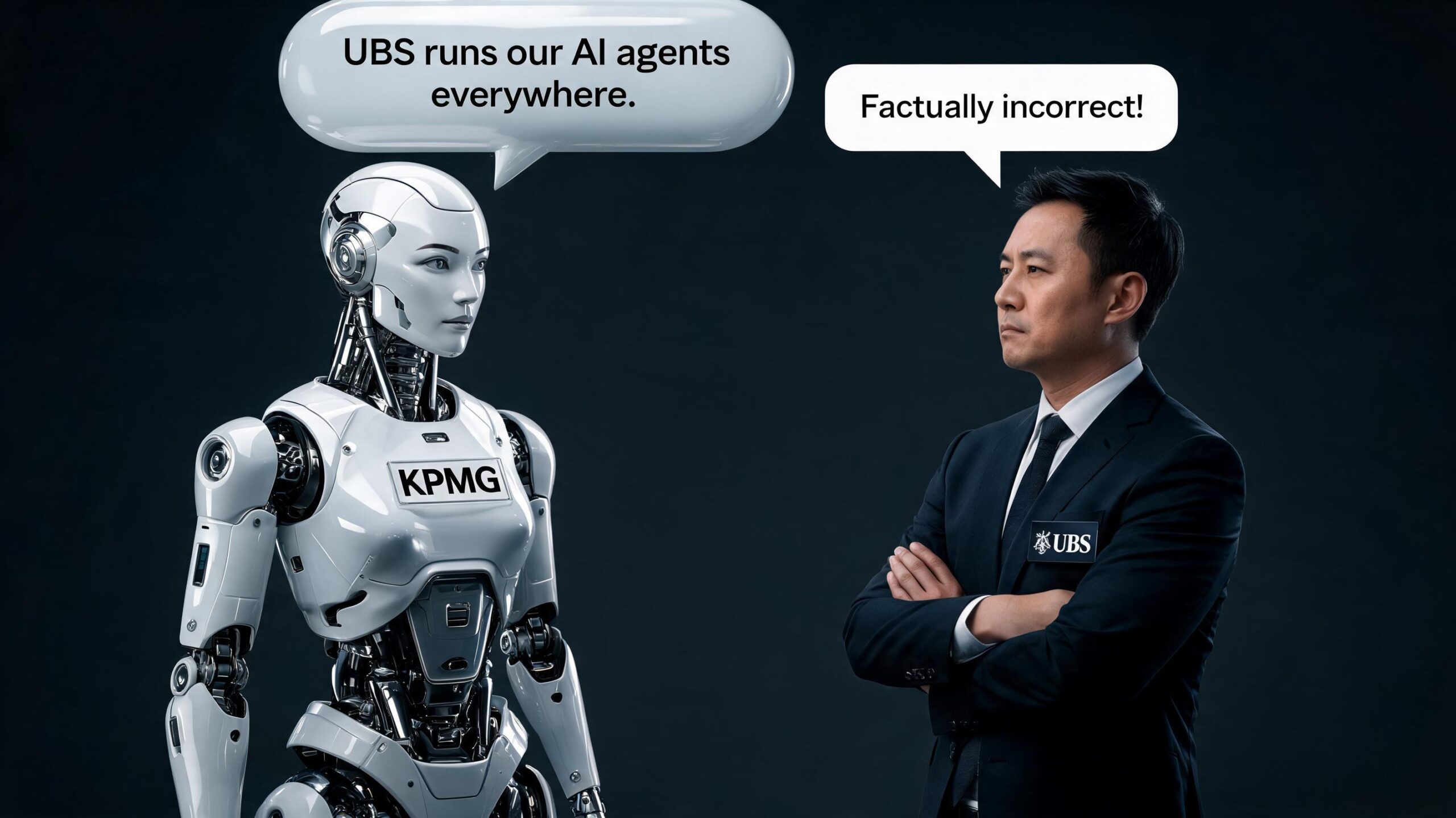
KPMG published a report titled “Redefining Excellence in the Age of Agentic AI.” It claimed Swiss bank UBS had deployed AI agents across investment advisory, risk management, and compliance monitoring. UBS called the assertions “factually incorrect.” It also claimed Swiss Federal Railways had become a “holistic mobility orchestrator” powered by AI agents. SBB confirmed this was “not accurate.” The Financial Times, tipped off by AI-detection firm GPTZero, verified both denials — along with several others.
The report selling agentic AI had been written, at least in part, by agentic AI.
KPMG has since pulled it from its websites pending investigation.
None of this means AI adoption in financial services is fiction. There are asset managers, family offices, and smaller banks running AI use cases that produce real, auditable results — cost savings, productivity gains, faster workflows. The difference between those firms and a KPMG thought-leadership report is simple: the use cases actually happened.
What GPTZero found, and why it matters
GPTZero is an AI-detection research firm that analyzes text for signs of machine-generated content and factual inaccuracies. It flagged the KPMG report and shared findings with the FT, which then independently verified the false claims directly with the named organizations.
This is not a minor editorial slip. The report was distributed by KPMG consulting groups across multiple countries, complete with local marketing contacts. The hallucinations were given regional sales packaging and sent to clients. The fiction was localized. The diligence was not.
GPTZero’s chief executive, Edward Tian, told the FT that Big Four firms publishing error-riddled content “poison the well of information.” He introduced a term worth keeping: second-hand hallucinations — what happens when a false claim acquires institutional credibility, gets cited by trade press and industry publications, and circulates as established fact before anyone checks the source.
The brand is the laundering mechanism. Nobody fact-checks KPMG, because the entire value proposition of KPMG is that you shouldn’t have to.
What else the report claimed
Beyond UBS and SBB, the report made similarly inflated claims about Transport for London and NHS Greater Manchester — both of which pushed back. Transport for London called its portrayal “misleading.” NHS Greater Manchester’s supposed AI agent capabilities traced back, per the FT, to a press release about a lung cancer tool that mentioned none of the claimed functions.
Four institutions. Four denials. One document, distributed globally, with no apparent verification that any of it was true.

KPMG wasn’t alone in this
It would be convenient to treat this as one firm having one bad week. The pattern disagrees.
Last month, EY retracted a study over fake footnotes — also caught by GPTZero. In April, elite law firm Sullivan & Cromwell admitted a bankruptcy court filing contained numerous AI-generated inaccuracies, including misreadings of the US bankruptcy code. The professions whose entire product is being right are now shipping work that is confidently, citably wrong.
The structural reason is not hard to find. Consulting firms have spent the past few years marketing themselves as the responsible adults of AI adoption — the advisers who will help you implement the technology safely and avoid exactly these errors. To attract those clients, they have pumped out hundreds of “thought leadership” pieces on AI.
Notice the incentive. When content exists to fill a marketing funnel, volume is the metric and accuracy is the overhead. You do not produce hundreds of authoritative reports per year with careful human verification of every claim. You produce them with the tool you are simultaneously selling.
The firms selling AI governance turned out to need it most.
KPMG’s response made the point unintentionally. The firm said it expects its people to follow guidelines on responsible AI use, “including human oversight to validate content and verify independent sources.” Those guidelines exist. They were written down. They were, evidently, also optional.
The boring alternative works
The failure mode here was not AI. It was scale theater.
A sweeping global narrative, dozens of marquee institutions, a cinematic title. Nobody could verify a document that ambitious, so nobody did. The size of the claim is what made the error invisible — and the institutional brand is what made it dangerous.
The opposite is unglamorous on purpose: a few small use cases. Each tied to a real workflow, each producing a number you can audit, none of them requiring a forty-page PDF with a title about redefining excellence. Modest claims have a quiet advantage. They tend to be checkable. They tend to be real.
This is the work we do with smaller financial firms — asset managers, family offices, and banks. No transformation narratives. No glossy PDFs. Just a few well-chosen automations that survive data privacy scrutiny and show up in next quarter’s numbers. Get in touch.
The glossy slides get the headlines. The boring use cases get the results.
For more insights about what AI can or cannot do, check out my book “Artificial Stupelligence: The Hilarious Truth About AI“.
Subscribe here to be the first to receive my insights.


